








Key takeaways
- Follow local rules carefully. Make sure that contracts, background checks, pay details, and registration deadlines meet the laws in each location.
- Protect candidates’ rights. Use fair and objective hiring tests, protect personal data, and make sure hiring technology follows the law.
- Keep transparent hiring records. Track hiring decisions, approvals, and records across your HR systems.
- Choose infrastructure that supports growth. Use local experts, automated tools, and an employer of record (EOR) to hire in new locations without setting up local entities.
An efficient global recruitment strategy helps you find skilled workers to serve customers and grow your business in new markets. Hiring in other countries supports growth, but you must follow local laws before making a job offer.
Your HR team needs a clear hiring process. Recruiters should know which questions to ask, candidates should understand the process, and legal reviewers should focus on exceptions. A clear process improves the hiring experience and keeps your company’s growth plans on track.
Your current hiring process won't work in every country. Local labor laws, contract rules, pay requirements, AI regulations, and data privacy laws all affect global recruiting decisions.
A compliance recruitment strategy helps you follow these rules with clear steps. You can set up approval processes, assign tasks, and update your hiring practices when laws change. Our global employment lawyer insights explain how to manage hiring laws across countries.
G-P’s Global Employment Platform combines technology and local expertise. Its Global Compliance Engine applies local employment rules within workflows, replacing fragmented, ad hoc hiring practices with institutionalized, automated workflows.
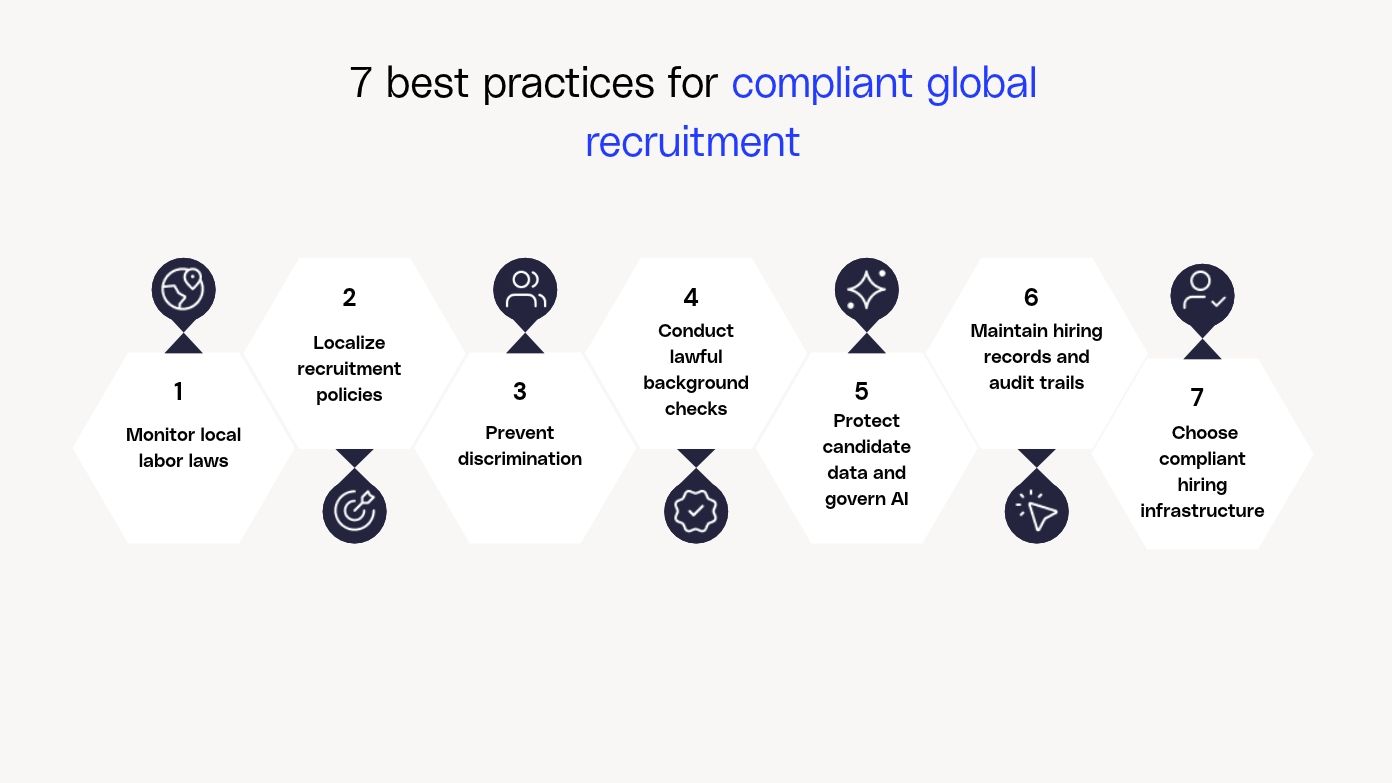
Best practice 1: Continuously monitor and adapt to local labor standards and statutory mandates
Keep in mind that labor statutes are fundamentally local; organizations cannot apply parent-company domestic policies across labor markets. Effective compliance in recruitment starts with a thorough knowledge of the local laws where you plan to hire. Before hiring candidates, check local rules for contracts, trial periods, work hours, registration, and worker status. Use a checklist for each country to improve hiring process compliance.
|
Domain |
Statutory example |
Employer risk |
|---|---|---|
|
Contract execution |
Nicaragua requires written contracts in Spanish, subject to statutory exceptions. |
Missing terms or an unsuitable template undermines compliance. |
|
Probation |
Nicaragua limits agreed probation for indefinite contracts to 30 days. |
A longer probation clause creates termination exposure. |
|
Shift maximums |
Nicaragua generally limits ordinary daytime work to eight hours daily and 48 weekly; other shifts have lower limits. |
Incompatible schedules create overtime and working-time breaches. |
|
Registry filings |
Ecuador requires worker registration within one month after starting employment. |
Missed filings create inspection and penalty exposure. |
|
Tax nexus |
Treaty-dependent agency rules address habitual contract conclusion and certain sales activities. |
Commercial activity creates corporate tax and filing exposure. |
For example, check Nicaragua's hiring rules in its labor code. Ecuador's 2025 registration update sets rules for sending worker information through the government's online system, including SUT workflows.
Check permanent establishment risk before hiring sales agents. Article 5(5) of the OECD Model Tax Convention explains when an agent's role in making contracts can create tax duties for your company. Follow the tax treaty and local laws that apply.
Check worker status before hiring contractors. Review how much control your company has, how freely contractors can work, and what their daily tasks involve. G-P Contractor™ uses automated checks to help you classify workers correctly. Make sure contracts match the ways people actually work.
Best practice 2: Develop a standardized recruitment policy tailored to local jurisdictions
Understanding how to create a compliance-driven hiring process means defining your decision standards with country-specific controls. In other words, think globally, but act locally.
A domestic template carries hidden problems across borders, such as restricted personal questions or omitting mandatory wage ranges.
Build your compliance recruitment policy around four checkpoints, and then tailor it to local jurisdictions:
- Requisitions: Approve location, employment model, budget, and tax review.
- Advertisements: Localize pay disclosures, language, and mandatory statements.
- Assessments: Use role-related questions, accessible tests, and consistent scoring.
- Offers: Confirm statutory terms, required language, and authorized signatures.
Train hiring managers before they interview. Give recruitment agencies the same approved questions and require written acknowledgment of local restrictions. Name an escalation contact so that teams can resolve unusual cases before making promises to candidates.
Give managers clear rules for scoring candidates based on their skills and actions. For example, rate how well a candidate solves a customer problem using set standards. Keep records explaining why you make each hiring decision, and send special cases to your legal team for review.
Move approved offers directly into employment agreements. Our Employment Contract Generator creates locally tailored contracts in minutes, reducing the manual work involved between selection and onboarding.
Best practice 3: Embed proactive anti-discrimination and equal opportunity safeguards
Anti-discrimination protections vary significantly worldwide. For this reason, you will need effective compliance in recruitment to protect candidates throughout your selection process. Local laws also protect candidates from unfair treatment based on marital status, political beliefs, union membership, or criminal history. These protections vary by location.
Strengthen your hiring process compliance using interviews, accessible assessments, and objective compensation criteria. Exclude personal questions unrelated to job duties.
The EU's Directive (EU) 2023/970 adds new rules for hiring and making sure employers follow the law. EU countries had until June 7, 2026 to add these rules to their own laws. Check each country's laws to see which rules apply.
|
Requirement |
Deadline or trigger |
Recruitment impact |
|---|---|---|
|
Initial pay or range disclosure |
In the job ad or before the interview, so candidates can discuss pay |
Approve objective, gender-neutral salary ranges before hiring. |
|
Salary-history ban |
During the hiring process, as required by local law |
Remove current and previous earnings questions. |
|
Gender-neutral vacancies |
When advertising and recruiting |
Review titles, wording, and selection practices. |
|
Burden of proof |
During certain pay discrimination cases under Article 18 |
Keep records that explain pay decisions and show your company followed the rules. |
Under the directive, you must prove that you follow fair pay rules when workers present facts that suggest discrimination. You also face stricter rules if you fail to share required pay information, though some exceptions apply. Our EU pay transparency rules guide provides a comprehensive roadmap covering gender pay audits, hiring rules, pay practices, and reporting requirements.
Best practice 4: Execute legally defensible, jurisdiction-specific background checks
A strong compliance recruitment plan sets clear rules for background checks based on the job and location. A pre-employment screening allowed in one country is not necessarily legal in another.
For global recruitment, keep records showing why your company used each screening, whether it's legal, how you informed candidates, and how you used the results. Do this before ordering any reports.
|
Screening type |
Jurisdictional permissibility |
Defensibility requirement |
|---|---|---|
|
Criminal |
France and Germany limit checks based on the job. Rules vary across Latin American countries. |
Make sure the check is legal, relates to the job, and follows GDPR Article 10 rules when they apply. |
|
Credit |
European countries have privacy rules that limit credit checks. |
Establish a specific job-related need, especially for financial responsibilities. |
|
Education |
Checking education records must follow local privacy laws. |
Contact institutions or authorized sources and collect necessary details only. |
|
Social media |
Public availability doesn't remove privacy duties. |
Limit review to relevant professional information; exclude private-account access and informal blacklists. |
Don't reject all candidates with criminal records. Some Latin American countries protect people from unfair treatment based on their criminal history. Others allow background checks only in certain cases. In Europe, credit checks are heavily restricted for all jobs outside the finance industry. Rules vary by country and job type.
Verify identity and credentials through primary sources. Give candidates a way to correct inaccurate findings. Our dedicated tutorial on international background checks offers step-by-step guidance on digital identity verification and local screening rules.
Best practice 5: Enforce rigorous candidate data privacy and algorithmic governance
Protecting personal data is an important part of compliance in recruitment. GDPR privacy rules also apply to some companies outside Europe, depending on where and how they collect and use personal data.
A consent checkbox doesn't always give your company the right to use personal data. Candidates usually feel they must agree to such use to get the job. However, the EDPB lawful processing guidelines state that people must have a real choice and not face unfair consequences if they refuse.
For job applications, check whether you need the data before signing a contract under Article 6(1)(b). For other uses, Article 6(1)(f) allows certain business needs, but you must weigh them against the candidate's rights. Sensitive personal data and criminal records involve extra rules. Keep records of how you protect data sent to other countries.
Knowing how to create a compliance-driven hiring process also means following rules for AI:
- AI risk levels: Annex III, Section 4, of the EU Artificial Intelligence Act covers AI tools used to screen job applications and rate candidates. Article 6 explains how to decide which tools carry a high risk.
- Banned uses: Article 5(1)(f) bans AI tools that try to detect workers' emotions, except for certain health or safety reasons.
- Human oversight: Article 14 requires human oversight of high-risk AI tools. Article 10 sets rules for data quality and reducing unfair bias.
- Candidate rights: Article 26 sets rules for telling candidates about AI use. Article 86 gives people the right to an explanation for certain major decisions made using AI.
The Commission's updated implementation timeline sets Dec. 2, 2027 as the date when Annex III high-risk AI rules take effect. Existing privacy laws, rules against discrimination, and bans on certain AI uses still apply.
Under NYC DCWP Local Law 144, covered AI hiring tools must have passed an independent bias check within the past year. Employers must share the results and give candidates advance notice.
Use G-P Gia™ to monitor regulatory updates and draft documents, including privacy notices. Follow our global HR compliance and AI guide when defining responsible generative AI implementation in HR.
Best practice 6: Establish immutable recordkeeping and audit trails
You need evidence to demonstrate hiring process compliance after a vacancy closes. Keep time-stamped archives of job advertisements, approved salary bands, scorecards, candidate messages, and offer approvals in a centralized platform.
Your compliance recruitment records also need AI tool versions, screening logs, human overrides, and applicable bias-audit certifications to prove nondiscriminatory hiring. Restrict access and log changes, so reviewers can reconstruct each decision.
Keep records showing any changes made, and control when they are deleted. Storing records forever goes against GDPR rules. Set clear deadlines for keeping records based on their purpose and local laws. Pause deletion when you need records for legal reasons, and then restart it when those needs end.
Connect your applicant tracking system to your HR system. Decide who manages the data, how information moves between systems, who can share it, and when it must be deleted. This helps prevent records from being lost.
G-P integrations connect employment data with systems including Workday, ADP, and SAP SuccessFactors. Verify what data each connection can share and whether it works in both directions. Don't assume every connection can share all data both ways.
Best practice 7: Deploy integrated international recruiting solutions and employer of record infrastructures
Choose international recruiting solutions that help you find the right candidates and hire them under local laws. For global recruiting, compare your operating needs before selecting the right infrastructure.
|
Expansion model |
Responsibility and best fit |
|---|---|
|
Local subsidiary |
Your company employs staff and manages registrations, payroll, benefits, and compliance. This option is best if you want an established operational presence. |
|
Traditional staffing agency |
The agency hires candidates or supplies workers under its service model. This option works well if you need short-term, seasonal staff, or independent contractors. |
|
Employer of record |
The EOR legally employs professionals and administers local employment obligations while you focus on day-to-day business responsibilities. An EOR is ideal if you need a workforce quickly but don’t have a local entity in the country. |
Our employer of record guide explains this division. With G-P EOR, we serve as the legal employer, handling compliant local contracts, payroll, benefits, and tax filings.
G-P’s Global Employment Platform supports compliance recruitment through agentic technology and local expertise across 180+ countries. The Global Compliance Engine validates employment actions against digitized local rules, while Gia provides real-time compliance guidance and automated document creation.
Customers also need guidance beyond administration. Rachel Salamone, chief people officer at Boston Dynamics, describes seeking “information about international norms and practices” from G-P. This perspective reinforces the value of combining employment infrastructure with G-P’s expertise. G-P is the #1 EOR according to all industry analyst reports.
Comparative regional recruitment compliance matrix
Cross-border recruitment requires strict adherence to regional pay transparency laws, data privacy mandates, and background screening regulations. G-P’s Global Compliance Engine tracks these local variations automatically, allowing you to hire global talent safely.
|
Region |
Contracts and probation |
Pay transparency |
Candidate data |
AI governance |
Background screening |
|---|---|---|---|---|---|
|
EU/EEA |
Each country has its own rules for contracts, language, and trial periods. |
EU pay rules become part of national laws. Check how they apply in EEA countries. |
Follow GDPR rules for using, storing, and sharing data. |
Follow EU AI Act rules and deadlines. Check how they apply in EEA countries. |
Follow local laws, including strict rules for criminal records. |
|
United States |
Federal, state, and contract rules |
State and municipal mandates |
Federal sectoral and applicable state privacy laws |
Local and state rules, including NYC |
Follow consumer reporting laws and rules that protect people with criminal records. |
|
Latin America |
Rules vary by country. Nicaragua has a 30-day trial period for contracts with no set end date. |
Country-specific equality and disclosure rules |
National privacy laws and transfer conditions |
Country-specific obligations |
Local restrictions and protected-status rules |
|
United Kingdom |
Employers must usually give workers written job terms on their first day. Trial periods depend on the contract. |
Equality rules; no EU-wide directive application |
UK GDPR and Data Protection Act |
Privacy, equality, and applicable sector rules |
Use checks that relate to the job. Follow rules when criminal record checks are allowed. |
The operational lifecycle for a compliant global hiring process
A compliant hiring lifecycle requires continuous legal verification from requisition to offer. G-P Assist automates this workflow, applying local labor law intelligence at every checkpoint so you can secure global talent without compliance delays.
Phase 1: Role design and requisition setup
- Key activities: Set location, duties, worker status, and pay ranges.
- Regulatory drivers: Employment, classification, and tax rules.
- Verification checkpoint: Legal and finance approve the job openings.
Phase 2: Sourcing, candidate outreach, and initial screening
- Key activities: Review advertisements, outreach, and privacy notices.
- Regulatory drivers: Transparency, equality, and data protection.
- Verification checkpoint: Recruiter approves localized materials.
Phase 3: Structured candidate evaluation and assessment
- Key activities: Use clear scoring rules to rate candidates and review AI tools.
- Regulatory drivers: Anti-discrimination and applicable AI rules.
- Verification checkpoint: Reviewers record their reasons for each score.
Phase 4: Credential verification and offer formulation
- Key activities: Check candidates' qualifications and approve job offers.
- Regulatory drivers: Background check rules and contract laws.
- Verification checkpoint: Team members review and send job contracts.
Phase 5: Onboarding and document life cycle governance
- Key activities: Complete required forms, system transfers, and retention controls.
- Regulatory drivers: Registry, payroll, and privacy rules.
- Verification checkpoint: HR confirms workers are registered and records stored safely.
Strategic imperatives for executive talent leaders
If your company is supported by automated, expert-backed systems, you can transform global recruitment compliance from an administrative obstacle into a competitive growth advantage.
Build hiring processes that follow local laws in each country. Assign team members to track legal changes, protect candidate data, and review AI tools. Track exceptions and update your processes to prevent them from occurring again.
Make legal reviews part of your plans to enter new markets. HR, legal, finance, and technology teams should work together. Before hiring in a new country, confirm how you'll employ workers, protect candidates, meet reporting rules, and keep required records throughout the hiring process.
Use hiring and employment tools to avoid setting up local entities and accelerate daily tasks. Set realistic start dates that allow time for work permits, required checks, and candidate needs.
Discuss your global hiring plans with G-P
With G-P EOR, you can hire in 180+ countries without setting up local entities and create compliant employment contracts in minutes. Bring local employment expertise and automated workflows into your hiring process so your team can focus on finding the right talent.
Request a proposal to schedule a consultation with G-P's global employment experts and review your international hiring plans.
 FAQs
What is compliance recruitment?
Compliance recruitment means following applicable employment, equality, privacy, and screening rules throughout the hiring process. This includes documenting decisions and applying controls to role design through onboarding.
How does global recruitment trigger corporate tax liabilities?
Hiring itself doesn't automatically establish a taxable presence. The risk depends on the professional's activities, contract authority, and working arrangements as well as domestic law and local tax laws.
Why is candidate consent insufficient under GDPR?
Consent fails when applicants lack a genuine choice or face consequences for refusal. Make sure you have a legal reason for using their data. Don't assume consent is always valid or always invalid.
How does an employer of record support hiring process compliance?
An EOR manages local employment contracts, payroll, benefits, and statutory filings. Your company still makes hiring decisions and manages workers daily.