



Key takeaways
- Access Lithuania's pool of skilled talent: With a large, educated workforce across IT, FinTech, biotechnology, and more, hiring in Lithuania gives you access to skilled workers in multiple industries.
- Navigate legal requirements: Lithuania's Social Security and Labour Ministry governs employment law, including minimum wage and workweek durations.
- Paths to hiring in Lithuania: Your global company has multiple paths to hiring talent in Lithuania, including hiring independent contractors, partnering with an employer of record (EOR), and establishing a subsidiary within Lithuania.
With its business-friendly regulations and tax policies, educated workforce, government support, and vibrant financial and technology sectors, Lithuania is full of potential as a place for companies to grow internationally. Currently, it ranks 27th out of 161 countries on Forbes’s prestigious “Best Countries for Business” list.
Before hiring employees in Lithuania, you’ll need to understand contracts, taxes, wages, benefits, and other employment laws. Our guide will tell you everything you need to know about hiring in Lithuania, from top hiring hubs, to key industries, to country-wide regulations.
What to know before hiring employees in Lithuania

1. Employment contracts and termination
Lithuanian law requires written contracts for all employees. Indefinite contracts are common, and fixed-term contracts are permissible for either two years or five years. Two-year contracts apply when it's the same job function, whereas the five-year timespan applies to any contract covering a different function. Fixed-term contracts for permanent-type jobs cannot exceed 20% of a company’s total contracts.
No matter the type, each contract must define the employee’s job location, position responsibilities, compensation, benefits, probation period, and termination requirements.
As of November 1, 2026, Lithuanian labor law allows employers and employees to agree on a probation period of up to 6 months — up from the standard 3-month limit — provided the employee's agreed monthly gross salary equals at least 2 national average monthly wages (VDU).
During the probation period, termination is possible with 3 days’ written notice. Afterward, employees can terminate their contracts by providing 14 days’ written notice. Companies can terminate employees’ contracts by providing 2 months’ written notice.
Employees terminated without fault must receive compensation based on the length of their employment. Those who have worked for their employer for less than a year should receive one month’s pay. Those who have worked longer should receive more: Employees who have worked for their employer for 20 years or more, for example, should receive 6 months’ pay.
2. Payroll and taxes
Employers in Lithuania are responsible for withholding payroll taxes. Employees generally contribute 19.5% of their pay to social security funds.
Employers must make these additional social security contributions as percentages of their payroll depending on contract type:
- Social insurance tax: 1.45% to 2.71%
- Long-term employment fund contribution: 0.16%
- Guaranteed fund contribution: 0.16%
For 2026, the general progressive personal income tax rates are 20% on annual income up to EUR 83,237.40, 25% on the portion between EUR 83,237.40 and EUR 138,729, and 32% on the portion exceeding EUR 138,729. Different rules may apply to certain types of income.
For tax periods beginning in 2026, the standard corporate tax rate is 17%, while the small business rate is 7%.
3. Wages and working hours
The minimum wage in Lithuania is EUR 1,153 per month, or EUR 7.05 per hour. The standard workweek in Lithuania is 40 hours — eight hours a day for five days. However, some employees, including those in healthcare, childcare, and certain communications services, can work up to 24 consecutive hours.
Generally, overtime is permissible as long as the total workweek does not exceed 48 hours in seven days or 180 hours in a year. With the written consent of an employee, up to 12 hours of overtime may be permitted within seven consecutive days as long as the maximum average workweek does not exceed 48 hours. Exceptions exist for collective agreements regarding extra overtime.
4. Leave and benefits
Lithuanian labor law covers issues such as holiday and vacation pay, vacations, sick leave, and parental leave. Employees receive state-sponsored healthcare as well as additional health insurance if their employers choose to offer it.
Employees should receive a paid day off for each of Lithuania’s 13 national holidays. They must usually receive an additional four weeks of paid vacation time annually and take at least 14 days at a time. If they are single parents of children under 14, they must receive 35 days of paid annual leave.
Lithuanian employees should receive sick leave each year. For the first two days of illness, they are entitled to receive 80% to 100% of their usual pay from the company. From the third through seventh day of illness, they should receive 40% of their usual wages. After that, they receive sick pay of 80% through Lithuania’s State Social Insurance Fund.
Employees may be absent from work for illness or injury for 120 consecutive days without risking termination.
Additionally, Lithuanian mothers should receive 70 days of maternity leave before the birth and another 56 days afterward. They receive a maternity leave allowance through the State Social Insurance Fund. Fathers, grandparents, and any other relatives who are primary caretakers of a child are entitled to parental leave as well.
Lithuania has state-sponsored healthcare, and all Lithuanian employees must register with their companies’ healthcare funds. The state covers many medical costs but not dental care. Employers can offer dental insurance if they choose, along with supplemental insurance to assist with other uncovered expenses.
Companies in Lithuania commonly provide additional benefits like phone, car, and fitness allowances.
5. Job market and workforce education
The job market in Lithuania is relatively stable. Unemployment rose to 17.81% in 2010 and has declined steadily since then, hitting a relative low of just over 6% in 2018 and 2019. The Covid-19 pandemic saw the unemployment rate rise again in 2020 to 8.43%.
Workforce education levels in Lithuania are rising with the education level of the overall population. If your company needs trained and educated employees, you will likely find a strong candidate pool in Lithuania. About 16% of the population in Lithuania has completed a vocational training program.
Younger generations tend to complete more formal education than the previous generations. As of 2018, 43% of Lithuanians aged 25 to 64 had completed their tertiary education and 56% of Lithuanians aged 25 to 34 had tertiary education.
Educational attainment in Lithuania correlates strongly with increased employment opportunities. As of 2018, 93% of adults with tertiary education were employed. The employment rate for adults with only secondary education was 16 percentage points lower. Workers with bachelor’s degrees also earned up to 55% more than workers with only secondary education.
Updates to Lithuania labor codes
Updates made to the Labour Code of the Republic of Lithuania include changes to rules surrounding employee termination, employment contracts, and pay transparency. Here are some of the key amendments that take effect beginning November 1, 2026:
- Probation period: For employees earning at least 2 times the national gross monthly wage (approximately EUR 5,256.40 in 2026), companies may extend probationary periods to 6 months (formerly 3 months).
- Justified dismissal rules: If termination is initiated without employee fault, the employer must state a clear, justified reason for the dismissal.
- Severance: If an employment contract is terminated without the will of either party, and the employee is at fault, the employer may be exempt from severance pay.
- Severance pay deadlines: For severance pay exceeding 1 average national wage, the parties may agree to allow the portion of a final settlement exceeding 1 average monthly wage to be paid up to 3 months after termination. Portions under 1 average wage, however, must be paid within 10 working days.
- Late-payment penalties: Penalties for delayed payments are approved by February 1 each year. These penalties are based on the consumer price index and multiplied by 5.
- Disability and on-call duty: No additional healthcare opinions are required to assign employees with disabilities passive on-call duty or overtime. Only the employee's consent is required.
- Collective agreements and strikes: The maximum duration of a warning strike extends from 2 to 4 hours, and remote working expense rules can be set via collective agreements.
EU Pay Transparency Directive Implementation
- Pay transparency and equal pay: Adopted under Law No. XV-969 on May 21, 2026, Lithuania formally transposed the EU Pay Transparency Directive into the Labour Code.
- Employer obligations: Employers are required to document remuneration systems. They must also objectively define job groups, provide reliable pay data, and justify pay differences with gender-neutral criteria.
Hiring models for global companies in Lithuania
There are a few options for expanding your business into Lithuania, each with their own pros and cons. These options include:
- Direct employer registration: establishing a legally registered entity in Lithuania to employ workers directly. You will independently manage payroll, tax withholding, statutory insurance, and other employer obligations.
- Employer of record (EOR): G-P EOR acts as the legal employer, handling administrative and payroll processes on behalf of your company, including contracts, withholding, contributions, and statutory benefits.
- Subsidiary or branch: a subsidiary will function as a separate legal entity, while a branch will function as an extension of your parent company and must be registered locally.
- Independent contractor: hiring independent contractors in Lithuania generally doesn’t require establishing a local entity or branch. However, there are significant penalties for misclassified workers, so legal tests must be followed when hiring them.
Top hiring hubs in Lithuania
Lithuania’s cities offer different strengths, from technology and financial services to manufacturing and logistics. Knowing where these industries are concentrated can help you focus your search for talent:
- Vilnius is the capital of Lithuania and is the home to multiple FinTech companies, such as Vinted and Revolut Bank UAB. Other major sectors in Vilnius include cybersecurity and other IT services.
- Kaunas is a growing hub for engineering and manufacturing.
- Klaipėda is a port city, and as a result, there is a strong maritime logistics presence, along with an emphasis on international trade and manufacturing.
- Šiauliai is a key site for manufacturing and logistics workers.
Key industries in Lithuania
Lithuania’s economy combines established industrial sectors with specialized technology and research expertise. Depending on your hiring needs, you can find skilled professionals across the following key industries:
- Information and Communication Technology (ICT): Home to multiple cybersecurity and IT firms, Lithuania has a strong information technology workforce.
- Fintech: Lithuania is a leading European Fintech center, hosting dozens of licensed e-money and payment institutions serving tens of millions of global customers.
- Lasers and photonics: Lithuania produces and exports advanced high-tech lasers and laser systems to research centers and industrial clients worldwide.
- Biotechnology and life sciences: Between multiple R&D centers and a sizable amount of pharmaceutical production, the life sciences sector has a strong presence within Lithuania.
- Manufacturing: Lithuania is one of Europe's top furniture exporters. It also exports quite a bit of dairy, meat, grain, and condiments.
- Petroleum refining and chemicals: With the Orlen Lietuva Mažeikiai refinery and major fertilizer producers like Achema, energy processing and chemical manufacturing remain vital industrial anchors in Lithuania.
- Transport and logistics: Lithuania's position between Central Europe and the Nordic-Baltic region, as well as Klaipėda's port presence, make the country a hub of transport and logistics activity.
The cost of hiring an employee in Lithuania
Factors like your company’s policies on benefits packages, bonuses, and allowances will determine the expense of hiring someone in Lithuania. In general, your company will need to consider direct and indirect costs like these:
- Company registration fees
- Job postings
- Recruitment agency fees
- Candidate-management tools
- Pre-employment checks
- Travel for interviews
- Direct compensation
- Benefits, including supplemental health coverage
- Bonuses
- Monthly allowances
In Lithuania, performance-based bonuses are common. As you budget for hiring new employees in Lithuania, keep in mind that you will likely need to reward your employees for their hard work each year to keep your company aligned with the Lithuanian business culture.
Hiring practices in Lithuania
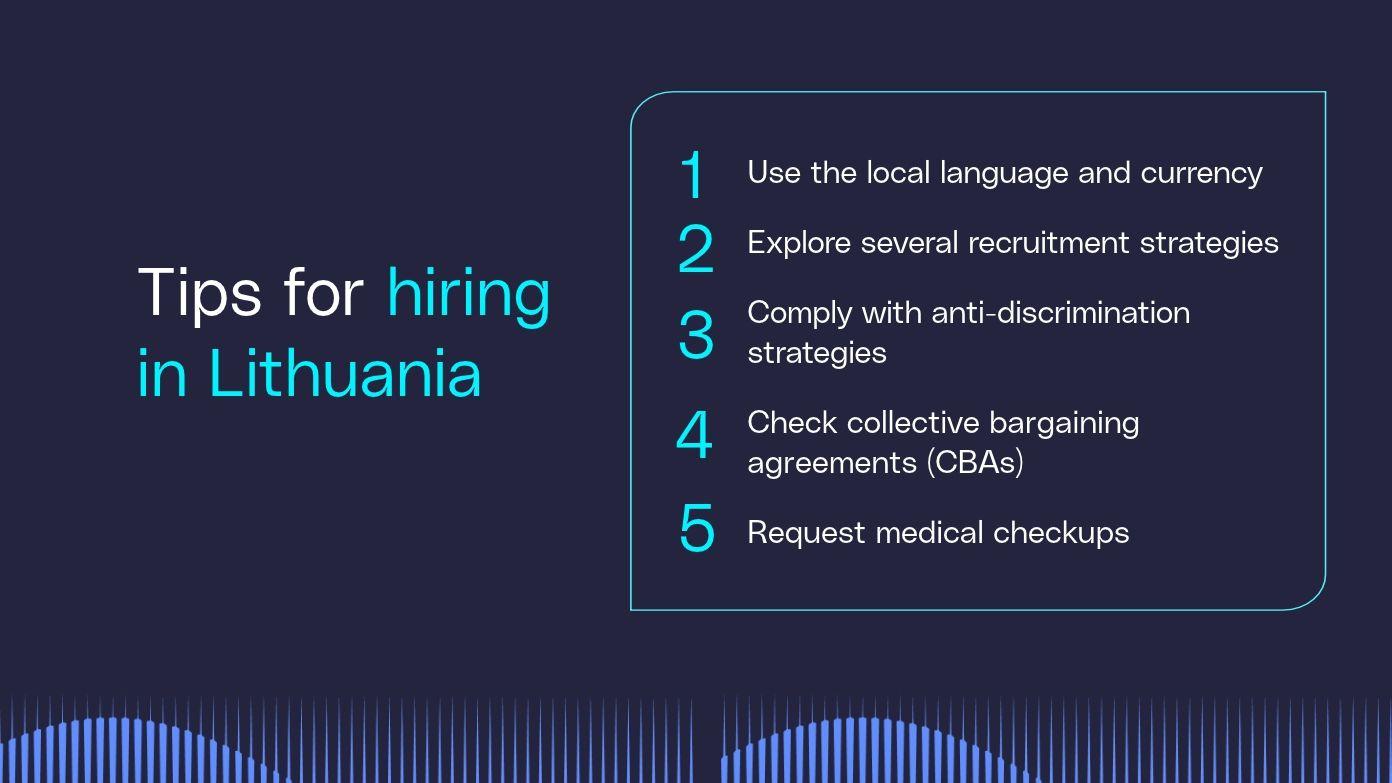
As you begin hiring, keep a few best practices in mind to comply with the law and help your company attract talented candidates. Here are a few tips for hiring in Lithuania most effectively:
- Use the local language and currency: The official language is Lithuanian, which more than 80% of Lithuanians speak as their first language. Polish and Russian are also somewhat common as first languages. Your company should use Lithuanian in official communications, such as employment contracts, and translate into other languages if necessary. You should also provide salary and benefit information in euros.
- Explore several recruitment strategies: Many international companies work with the State Labor Exchange office to recruit new employees. Your company might also partner with a third-party recruitment agency, lean on personal contacts for word-of-mouth recruiting, or advertise on online job boards, recruitment websites, or your company’s website.
- Comply with anti-discrimination laws: Lithuanian laws prohibit employment and hiring discrimination based on race, gender, nationality, religion, sexual orientation, age, disability, place of origin, family or marital status, social status, beliefs, or membership in public or political groups. Discrimination against employees on health-related grounds is also illegal. Your company should refrain from asking interview questions related to these protected categories or considering these protected characteristics in hiring decisions.
- Check Collective Bargaining Agreements (CBAs): Lithuania has relatively few trade unions or CBAs. Still, your company should check with reputable industry sources to determine what CBAs may influence the terms of your employment contracts.
- Request medical checkups: Pre-employment physicals are mandatory in Lithuania if your company is hiring employees who are under 18, will work in positions that could pose occupational risks to their health, or will work at night or as shift workers. Be sure to complete the necessary steps to ensure healthy teams.
Steps to hiring employees in Lithuania

When you’re ready to hire in Lithuania, you can expect a process that’s similar to the one you’re likely familiar with in your own country. There are five basic steps: advertising the job, evaluating applications, interviewing candidates, sending job offers, and onboarding new employees.
1. Advertise job vacancies
Create detailed job descriptions that define the role. You'll need to include a list of responsibilities and qualifications as well as be prepared with a written contract of employment for the worker you eventually hire. Post your job vacancies on job boards that are popular in Lithuania, including CVbankas.lt, Dirbam.lt, and CV Online.
2. Evaluating job applications
Once you've received applications and reviewed the associated CVs, you'll need to screen the applicants. Base decisions on applicants' qualifications, experience, and fit for the role; keep everything focused on applicability to avoid potential discriminatory selection practices.
3. Interviewing candidates
Once you've selected a shortlist of candidates, you'll need to interview them. Interviews may be done in person or virtually. G-P Gia™ can help you during this process. Use it to create interview questions that align with all applicable employment regulations in Lithuania.
4. Making job offers
When you're ready to offer a candidate the position, you'll need to make a formal offer. Have a written contract and all appropriate documents prepared, including:
- Signed offer letter/employment agreement: Your written employment contract will outline the terms of employment, including compensation, benefits, and more. The new hire needs to sign this before the working relationship can be established.
- Identity and address proof: Be sure to collect proof of address and government-issued ID to ensure your new employee is legally allowed to work in Lithuania.
- Tax identification, payroll, and enrollment info: You'll need your hire's government-issued tax identification number for payroll purposes. Be sure to also collect payroll and enrollment information to ensure deductions for health insurance, taxes, and other benefits are made appropriately.
- Bank details: Prepare for direct deposit with the employee's bank details.
5. Onboarding new employees
When you have a signed employment contract and the worker's information, you can begin to onboard your new employee. Be sure to complete any statutory registrations while providing training on company policies and job duties.
If you’re using G-P EOR, you won’t have to worry about the administrative burden of onboarding. We streamline the process so that you can focus on training the new hire and integrating them into your company culture.
Hiring contractors in Lithuania
Employees vs. independent contractors
As in many countries around the world, employees are classified differently from independent contractors in Lithuania. Contractors provide services to a business or organization without being official employees. Contractors usually own the equipment they use to do their work, and they have more autonomy in how they work in exchange for fewer benefits. While there is no limit to the time independent contractors may serve an employer, fixed-term employment contracts cannot exceed 2 or 5 years, depending on the work the person under such contract performs.
Penalties for misclassification
Misclassifying an employee as an independent contractor carries significant risk. Violations may result in administrative fines ranging from EUR 868 to EUR 2,896 for the first offense, increasing significantly for repeat offenses. Income taxes, back taxes, and missed benefits may also be retroactively required along with immediately instating the misclassified contractor as an employee. The applicable penalties and consequences may depend on the nature of the violation and the circumstances of the engagement.
How to pay contractors
Contractors will invoice your company independently, which gives them more say in the payment method. Partnering with a global payroll partner like G-P can help make the payment process go more smoothly.
Simplify contract generation, ensure worker classification, and pay contractors in minutes instead of hours with G-P Contractor™. Get peace of mind with real-time status updates on your payments; G-P Pay gives you end-to-end payment visibility, transparent FX costs, and instant local currency payouts across multiple markets.
Hire employees and contractors in Lithuania with G-P
Our Global Employment Platform and its AI-powered products, EOR, Contractor, and Gia, support companies as they build and manage global teams.
G-P is the recognized leader in global employment with more than a decade of experience; the largest team of HR, legal, and compliance experts; and a global proprietary knowledge base.
Make your expansion to Lithuania easier with G-P. Contact us or book a demo today.
 FAQs
What are the main ways to hire in Lithuania?
The main ways to hire in Lithuania include opening a subsidiary and registering your company directly with Lithuanian business authorities. You can also partner with an employer of record like G-P EOR, to act on your behalf and simplify hiring in Lithuania.
How can a U.S. company hire employees in Lithuania?
U.S. companies can partner with an employer of record (EOR) like G-P EOR to hire employees in Lithuania without opening a subsidiary or registering directly with Lithuanian authorities. This also helps you avoid misclassifying employees as contractors and opening your U.S. company up to liability.
How can you avoid contractor misclassification risk in Lithuania?
You can avoid misclassifying contractors by staying up-to-date with Lithuanian labor regulations. Misclassifying an employee as a contractor can result in a variety of fines, as well as backdated income taxes and benefits.
How do you choose between employees and contractors in Lithuania?
Contractors have a greater degree of autonomy than employees, but employees see greater benefits and open-ended employment contracts. If you need a fixed-term worker, contractors may be ideal, but for long-term work, you may want to hire official employees. The best choice for your company depends on job needs and your company's goals.
Is a Lithuanian entity or an employer of record (EOR) better for hiring employees?
Partnering with an employer of record (EOR) can simplify how your global company hires and operates in Lithuania. However, if your company plans to continue expanding into Lithuania or operate long-term, establishing a full entity may also be a good idea. The right course of action depends on business needs, company goals, and more.