



Key takeaways
- A WFOE, or wholly foreign-owned enterprise, is a limited liability company (LLC) that operates in China, but is owned by global investors.
- There are three main types of WFOEs: consulting and professional services, trading, and manufacturing. Each of these has their own unique functions and specific requirements for setup.
- G-P EOR can help you hire quickly and compliantly in China without the hassle of setting up a WFOE.
In China, international investors can directly operate an LLC by establishing a WFOE, known as a wholly foreign-owned enterprise. This setup gives you the opportunity to expand into one of the largest economies.
Read on to learn more about WFOE setup, the three main types of WFOES, and the rules and regulations governing these entities.
What is a WFOE in China?
A WFOE, or wholly foreign-owned enterprise, is an option for global expansion into China. A WFOE is a limited liability company that operates in mainland China but is owned and funded by one or more international investors. WFOEs operate under China’s PRC Company Law and Foreign Investment Law. This is a change from China’s previous dual-track system, when global and domestic companies were governed by different laws.
Once your WFOE is registered and licensed, you can hire local talent, enter into contracts, and submit commercial invoices without a local partner. A WFOE can also receive payments in RMB, China’s national currency, and issue official tax invoices called fapiao. This includes value-added tax (VAT) invoices.
Types of WFOEs in China
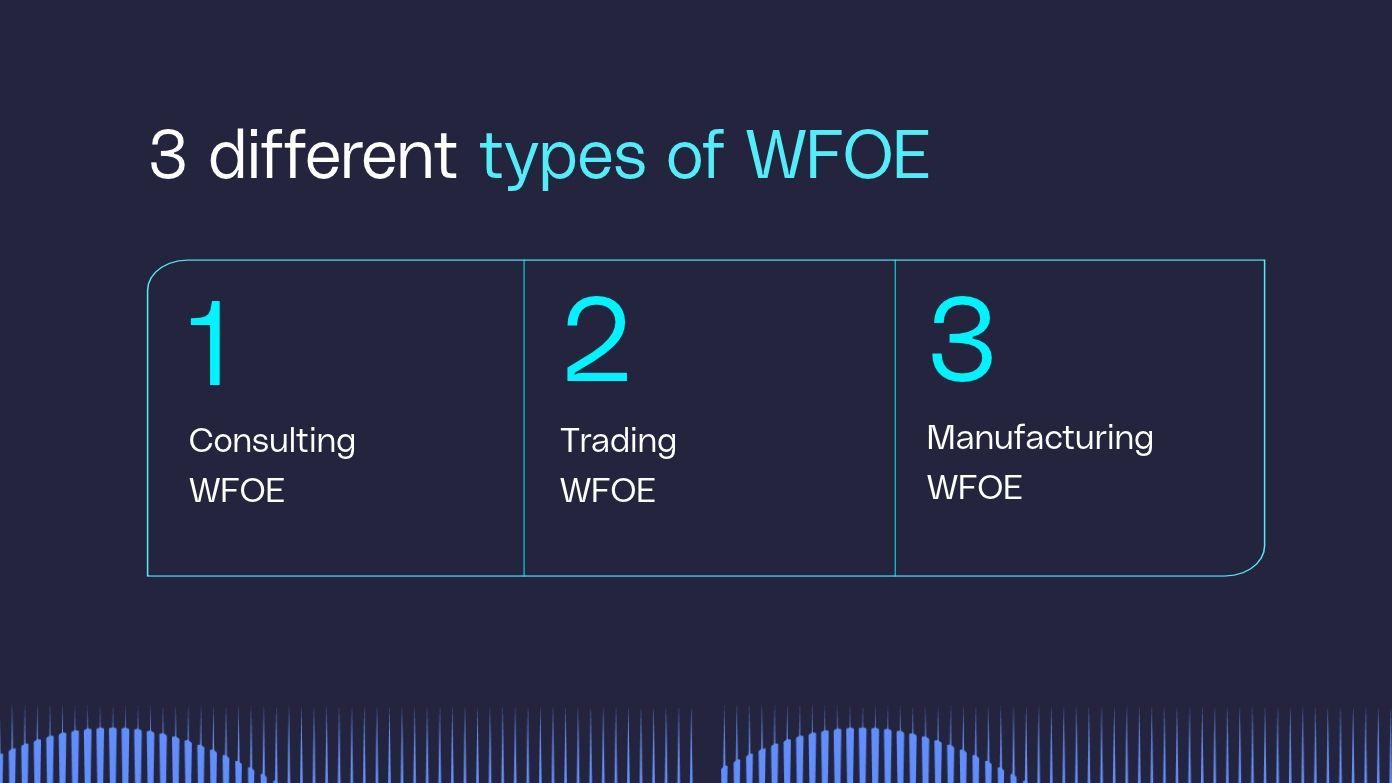
There are three main types of WFOEs in China: consulting and professional services, trading/commercial, and manufacturing. This chart breaks down the basic functions and startup requirements for each type:
|
WFOE type |
Advantages |
Examples of activities |
Permits and registrations needed |
|---|---|---|---|
|
Consulting and professional services |
Lower startup costs Minimal environmental reviews |
Consulting Advising Market-entry support Marketing Management services Technology support Project coordination |
|
|
Trading/commercial Also known as a foreign-invested commercial enterprise, or FICE |
Can buy, sell, import, and export goods across mainland China |
Wholesale Retail Distribution Sourcing Commission agency Domestic resale Import/export After-sales support E-commerce |
|
|
Manufacturing |
Owners have direct control over their production sites |
Production Assembly Processing Packaging Testing Quality control Procurement Storage Domestic sales Import/export |
|
Requirements for a WFOE
Here are the key legal and structural requirements for establishing a WFOE in China. This guide will help you stay compliant as you expand your global business:
Understand registered capital regulations
- Registered capital must be fully paid within five years after the company is formed.
- Owners must plan carefully so they don’t promise more than they can fund within that timeframe. It’s helpful to remember that the borrowing gap is the total investment minus the registered capital.
- Companies should confirm SAFE foreign-exchange and foreign-debt rules when borrowing funds across borders.
Establish corporate governance
- A company can use a board of directors or appoint one director, depending on its size and structure.
- Shareholders can be global companies or individuals, and they can decide major company matters.
- Legal representatives can sign documents and bind the company.
Register a commercial business address
- A WFOE needs a valid business address that’s compliant with local zoning laws and approved by a market regulator.
- The names, dates, and address details on the Official Real Estate Ownership Certificate must match what’s on the lease.
- Chinese regulatory authorities can “blacklist” companies that use invalid addresses into the Directory of Abnormal Operations.
Map your business scope
- The State Administration for Market Regulation, or SAMR, governs company registration. A company’s business scope and planned activities must be SAMR-compliant.
- Some activities may require additional licensing or permits, depending on the industry.
- Companies must confirm the business scope and permit needs before filing for registration, as local and sector rules can differ.
Step-by-step WFOE registration process
Setting up a WFOE in China can be complex. This step-by-step guide breaks down the process to help you start hiring in China quickly and compliantly:
Phase 1: Complete pre-registration documents
- Step 1: Submit a corporate name reservation with the local AMR platform.
- Step 2: Legalize parent company documents.
- Step 3: Get certified Chinese translations of all incorporation records.
- Step 4: Validate commercial leasing and zoning requirements.
Phase 2: File SAMR and apply for licensing
- Step 5: Submit a corporate dossier, Articles of Association, and Foreign Investment Information Report.
- Step 6: Verify the identities of all global and domestic executives.
- Step 7: Get an official business license with an 18-digit Unified Social Credit Code (USCC).
Phase 3: Complete post-licensing statutory activations
- Step 8: Get an official company seal, known as a chop, and register it with the Public Security Bureau (PSB).
- Step 9: Register with the State Taxation Administration (STA) and Golden Tax System configuration.
- Step 10: Complete a SAFE foreign exchange profile and open a corporate bank account.
- Step 11: Set up social insurance and enroll in a housing provident fund.
Time and costs to establish a WFOE in China (2026)
The estimated time to establish a WFOE varies between each type. Standard consulting WFOEs can take about two months to establish. Trading WFOEs typically take two to four months. Complex manufacturing WFOEs or WFOEs in highly regulated industries can take three to six months.
|
Type of WFOE |
Average startup time |
|---|---|
|
Consulting |
Two months |
|
Trading |
Two to four months |
|
Manufacturing |
Three to six months |
There are also critical bottlenecks to be aware of when establishing a WFOE. Banks must conduct anti-money laundering (KYC) reviews, which can include site visits. Cross-border document authentication can have long processing times. Business scope mapping with local market supervision bureaus can also take longer than expected.
WFOE startup costs are also highly variable. While there isn’t a statutory minimum registered capital, there are average expected costs by WFOE type. The average is RMB 100,000–500,000 for consulting WFOEs, RMB 500,000 to 1M for trading WFOEs, and over RMB 1M for manufacturing WFOEs.
There are also ongoing compliance and legal expenses to consider, including statutory audits, tax declarations, registered address lease fees, and legal retainers.
Advantages of setting up a WFOE in China
Many global companies choose to set up WFOEs, rather than a joint venture (JVs) or a representative office (RO). Here are some reasons why a WFOE may be a good option for hiring in China:
- Operational autonomy: A WFOE gives you more control over hiring decisions and operational roadmaps.
- Direct RMB revenue and invoicing: WFOEs have independent corporate legal status, which allows them to submit commercial bills and invoices.
- Intellectual property (IP) protection: There’s a dedicated corporate firewall for proprietary technology and trade secrets, which helps protect WFOEs.
- Independent employment authority: Under the PRC Labor Contract Law, WFOEs can hire employees without using a staffing or dispatch agency as the legal employer.
WFOE vs. employer of record (EOR)
While there are benefits of setting up a WFOE in China, the administrative process and speed to market isn’t right for everyone. Partnering with an EOR can be a more fitting solution if you’re looking to start hiring immediately, or want to test the market before setting up an entity.
The benefits of an EOR include:
- Faster speed to market: Using an EOR allows you to hire workers in minutes, rather than waiting 8–16 weeks for WFOE incorporation.
- The "bridge to entity" model: An EOR can be used to hire immediately and generate revenue while WFOE incorporation paperwork is pending. You can then transition employees once the WFOE is live.
- No five-year capital rules: Using an EOR gives you the flexibility to explore market demand without locking up capital under China's five-year paid-in rules.
- Entity liquidation risk: While closing a WFOE can take 6–12 months and involve tax audits, an EOR gives you the agility to leave a market if needed.
- Seamless compliance: G-P EOR acts as the legal employer, handling administrative and payroll processes on behalf of your company, including contracts, withholding, contributions, and statutory benefits.
Expand into China with G-P
G-P is the recognized leader in global employment with more than a decade of experience, the largest team of compliance experts, and a global proprietary knowledge base. Our Global Employment Platform and its AI-powered products – EOR, Contractor, and Gia – support companies as they build and manage global teams.
G-P EOR allows you to expand into China without the hassle of setting up a WFOE. G-P EOR provides an extra layer of legal protection, relieves administrative burden, and frees up your HR team to manage operations.
Book a demo to see exactly how G-P EOR can support your growth into China.
 FAQs
What’s a WFOE in China?
A WFOE, or wholly foreign-owned enterprise, is a set-up option for global employers looking to expand into China. WFOEs are governed by Chinese law but owned and operated by international investors.
What’s the minimum registered capital for a WFOE in China?
There isn’t a universally required minimum capital, but sector-specific requirements may apply. All registered capital must be fully paid within five years of incorporation.
How long does it take to set up a WFOE in China in 2026?
Setting up a WFOE in China takes roughly 6–12 weeks, although timelines can vary. Owners need to file required documents, get approved for business licenses, set up banking, and complete necessary tax filings.
Can an international company hire employees in China without a WFOE?
Yes, if they partner with a compliant employer of record like G-P EOR or work with a Representative Office (RO).
What’s the difference between a WFOE and a Representative Office in China?
A WFOE is an internationally owned company that can sell products or services, issue invoices, and hire employees directly in China. A Representative Office can conduct research, do marketing, and build professional relationships, but can’t earn revenue or hire employees in China.