










The United Arab Emirates (UAE) is a federation made up of seven territories called emirates. Its economic hubs offer a skilled international workforce and a business-friendly environment. The country’s strategic location connects Europe, Asia, and Africa, making it an attractive base for regional and global expansion. But these advantages come with a maze of employment regulations.
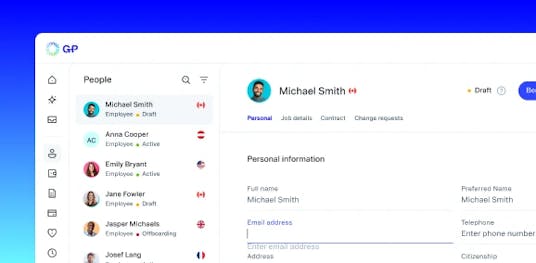
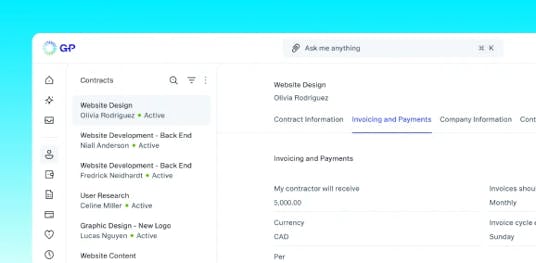
With a UAE employer of record, you don’t need to worry about these regulations. As a global EOR, G-P takes care of everything, from contracts to payroll. We make international hiring seamless, so you can focus on growing your business.
Simplify hiring in the UAE with an employer of record
The UAE has three main business structures — mainland, free zone, and offshore — each with its own employment regulations. The structure you choose depends on what your business does, its ownership, and desired target market.
The primary law governing mainland business structures is the Federal Decree-Law No. 32 of 2021, known as the UAE Labour Law. Free zones, such as the Dubai International Financial Centre (DIFC) and Abu Dhabi Global Market (ADGM), have independent legal systems that differ significantly from mainland laws.
Mainland and free-zone employers must have a local business license to hire in the UAE. This allows them to sponsor work and residency visas. Operating without the correct license and visa sponsorship can lead to severe penalties, including fines and employee deportation.
A UAE EOR, like G-P, takes the complexity out of navigating this system. We act as the legal employer, so you can hire in the UAE without setting up a local entity.
The EOR hiring process in the UAE:
-
Partner with a global employment expert. Choose an EOR with deep expertise in the UAE as they’ll guide you through the local legal landscape.
-
Source your ideal candidate. You find the best talent, and the EOR handles the rest.
-
Generate a compliant employment contract. Your EOR drafts a locally compliant contract in line with the UAE’s labor laws, including salary, working hours, and notice periods.
-
Onboard and manage your team. The EOR manages the entire employment lifecycle. This includes managing your team members’ payroll and administering benefits.
Employment contracts in the UAE
Under current UAE Labour Law, contracts must be fixed-term. There’s no limit on the length of the term and they can be renewed multiple times.
Contracts must be in writing. We recommend writing them in Arabic and English. Keep in mind that the Arabic version will prevail in case of any dispute or inconsistency. Contracts should clearly outline employment terms, including compensation, benefits, and termination requirements. An offer letter and employment contract must state compensation in United Arab Emirates dirham (AED).
A UAE EOR drafts compliant contracts on your behalf, protecting you from legal risks. Contracts are structured in line with local labor laws and tailored to your needs, setting clear expectations around compensation, working hours, and termination from the start.
Leave entitlements in the UAE
Working hours in the UAE
The standard workweek is 48 hours, although some employers expect fewer hours. Maximum working hours are eight hours per day. The workweek is typically Monday to Friday, but companies can choose different days. The federal government has adopted a 4.5-day workweek, but this isn’t mandatory for the private sector.
Employees get overtime pay of at least 25% more than their normal pay. If they work between 10 p.m. and 4 a.m., they’re paid 50% extra, but this excludes shift workers. When an employee works on a rest day, they get a substitute rest day or they must be paid 50% more than their normal day's wage.
The workday is two hours shorter for all employees during the holy month of Ramadan.
Public holidays in the UAE
Employees in the UAE get 13–15 paid public holidays, depending on the Islamic lunar calendar and government announcements. The number of days for Eid al-Fitr and Eid al-Adha varies. The official public holidays are:
-
New Year's Day (1 day)
-
Eid al-Fitr (3–4 days)
-
Arafat Day and Eid al-Adha (4 days)
-
Hijri New Year (Islamic New Year) (1 day)
-
The Prophet's Birthday (1 day)
-
Commemoration Day (1 day)
-
UAE National Day (2 days)
Vacation days in the UAE
Employees get at least 30 calendar days of annual leave after completing a year of service for the same employer. Those who’ve worked for less than a year for the same employer accrue leave as follows:
-
During probation: Employees don’t accrue leave.
-
After probation: They get two days of leave for each month of service.
Employees are paid for unused annual leave on termination. This payment is calculated based on their basic salary.
Sick leave in the UAE
Employees get 90 days of sick leave. Sick leave is paid as follows:
-
First 15 days: Full pay
-
Next 30 days: Half pay
-
Remaining 45 days: Unpaid
Employees aren’t paid for sick leave during probation.
Maternity and parental leave in the UAE
Expecting employees get 60 days’ maternity leave: 45 days at full pay and 15 at half pay.
Employees can take up to 45 extra days’ unpaid leave for any maternity- or pregnancy-related illness. The employee gets an extra 30 days’ fully paid leave if the newborn is sick or born with a disability. This can be extended by another 30 days’ unpaid leave.
All new parents get five days’ paid parental leave. This can be taken at any time in the first six months after birth. For mothers, this leave is on top of the total 60 days’ maternity leave.
How an employer of record in the UAE helps manage leave entitlements
A UAE EOR ensures you comply with local leave laws by managing entitlements, from annual and sick leave to parental leave. An EOR handles all the admin, so you don’t have to.
Health insurance and supplementary benefits in the UAE
Healthcare is accessed through a combination of public and private providers, and is mostly based on mandatory health insurance schemes.
Employers must provide health insurance for most employees. In Abu Dhabi, this includes the employee's dependents — their spouse and up to three children under 18. In Dubai, the employee is responsible for dependent coverage. Paying for employee health insurance in other emirates isn’t mandatory, but it’s best practice. The UAE government has plans to expand mandatory health insurance nationwide.
Common supplementary benefits in the UAE include:
-
Housing allowance or company-provided accommodation
-
Transportation allowance or company car
-
Annual home-visit airfare or travel allowance for employees and sometimes their families
Bonuses in the UAE
Bonuses aren’t mandated for private sector employees. Employment contracts or company policy determine whether an employee gets a bonus. Bonuses that are paid regularly or are promised in writing become an enforceable entitlement.
Employers with 50 or more employees must have transparent bonus policies and communicate them to staff.
How an employer of record helps with benefits in the UAE
A UAE employer of record manages and administers mandatory and supplementary benefits so you don’t have to. Using a UAE EOR ensures you offer competitive benefits while complying with local regulations.
Termination and severance in the UAE
Probation can be up to six months. During this time:
-
An employer can terminate employment with 14 days’ written notice.
-
Employees must give 14 days' notice if they’re leaving the country, or one month's notice if they’re switching to another UAE employer.
A contract can be ended for a valid reason after probation. The notice period must be between 30 and 90 days, as stated in the contract.
Employees who’ve worked for a company continuously for at least one year get end-of-service pay (severance). This payment is based on their last basic salary when their job ends. It’s calculated as:
-
21 days' basic salary for each of the first five years of service
-
30 days' basic salary for each additional year
-
The total payment is capped at two years' basic salary
For example, an employee who’s worked for a company for seven years would be paid as follows:
(21 days x 5 years) + (30 days x 2 years) = 165 days
A UAE EOR simplifies employee offboarding. We ensure your business complies with UAE labor law notice periods, severance, and more.
Payroll and taxes in the UAE
There’s no personal income tax in the UAE. However, employers must budget for employee health insurance premiums in Dubai and Abu Dhabi. We suggest budgeting AED 1,000–5,000 per employee per year for standard coverage, with higher costs for more comprehensive plans or dependents.
We also recommend setting aside 8.3% of an employee’s salary each month to fund the end-of-service gratuity payment.
A UAE employer of record handles all aspects of payroll management, including health insurance payments and accruing a percentage of employees’ salaries for the end-of-service payment.
Choosing the right EOR in the UAE
When choosing an employer of record UAE, consider the following:
-
Compliance expertise: The right EOR has in-depth knowledge of UAE labor laws and tax regulations.
-
Comprehensive EOR solutions: Choose an EOR that manages all aspects of employment, including payroll processing, tax remittances, benefits administration, leave management, and offboarding.
-
Scalability and flexibility: The EOR should accommodate your needs, whether you're hiring a single employee or a global team, and grow with your business.
-
Technology and integration: An AI-powered EOR simplifies onboarding, management, and employee payment. Look for an EOR that integrates with existing HCM, PEO, or payroll systems to streamline operations.
-
Transparency and communication: Choose an EOR that offers clear communication channels, transparent pricing, and regular updates on compliance changes.
-
Reputation and references: Research the EOR's reputation, customer testimonials, and industry recognition to ensure they have a track record of reliability and success. As the #1 EOR according to all industry analyst reports, G-P has a solid reputation and extensive global employment experience.
-
Data security and compliance. Ensure your EOR follows strict data security protocols like GDPR. This is critical for protecting sensitive employee information and maintaining compliance.
Use G-P EOR for global hiring in the UAE
G-P EOR is the award-winning, AI-enabled global hiring solution that empowers startups, SMBs, and enterprise businesses to build global teams with ease. Onboard, manage, and pay top talent in over 180 countries in minutes, without the complexity of entity setup.
G-P EOR is the preferred partner for leading HCM, PEO, and payroll platforms. Bring your workforce data together in one place to maintain existing workflows while keeping consistent and accurate data across your integrated systems.
Request a proposal to start hiring in the UAE today.